
The 10 Renovation Mistakes Australians Keep Making — And the Fixes That Actually Work
137 real homeowners handed me their horror stories. I handed them back a checklist. Here it is.
The 10 most common Australian renovation mistakes are: going to tender without a Scope of Works, letting tradies make design decisions by default, accepting "builders range" finishes, misunderstanding PC and PS items, choosing the cheapest quote, not being present on site, failing to budget a 20% contingency, using weak contracts, not checking licences and insurance, and assuming trades will coordinate with each other. Every single one is preventable — with the right knowledge before you sign anything.
This week, someone on Reddit asked a question so simple it should have had a simple answer.
"What's the one thing you wish you'd known before getting your first renovation quote?"
It didn't get a simple answer. It got 137 of them — from real Australian homeowners who'd been through the machine and come out the other side wiser, poorer, and in several cases, still fighting with their builder.
I read the whole thread. I responded in the comments. And then I wrote about it here — [you can read the full breakdown of the Reddit thread and what it revealed about the Australian renovation industry in this post].
But one thing kept nagging at me as I read.

Every single horror story in that thread was preventable.
Not with luck. Not with a better builder. With knowledge — specifically, the kind of knowledge the industry has zero financial incentive to hand you before you sign anything.
So here it is. The 10 most common renovation mistakes, ranked by how often they appeared in that thread and in my own years of watching homeowners learn these lessons the hard way. Plus — and this is the part nobody else gives you — the actual fixes.
No fluff. No "communicate with your tradie." Real, actionable, use-it-today advice.

THE TOP 10 RENOVATION MISTAKES
01. Going to tender without a Scope of Works
The undisputed number one. The root cause of more blown budgets, broken relationships, and badly installed rangehood flues than any other single factor.
A Scope of Works is a detailed, written document that tells every tradie exactly what they're building, to what specification, using what materials. Without one, your three quotes are three different projects. You cannot compare them. You cannot hold anyone to them. You are, essentially, renovating on a handshake and a prayer.
The consequence: Variations. Endless, expensive variations. The builder fills the gaps with whatever is cheapest and fastest — then charges you to change it.
02. Letting tradies make design decisions
An air conditioning installer who centred a unit on the wall "like art." A tiler who chose grout colour from whatever was in his van. Powerpoints in locations that defy spatial logic. These aren't made up — they're straight from the Reddit thread, and I've seen every version of them in my own projects.
Tradies are skilled professionals. Design is not their profession. When there's no documented plan, decisions get made by whoever is on site at the time — with efficiency as the priority, not aesthetics or liveability.
The consequence: A home that functions like a construction site and looks like one made the design decisions.
03. Not understanding "builders range"
Two of the most dangerous words in a renovation quote. "Builders range" means a budget allowance for finishes not yet specified — tiles, carpet, stone, tapware, handles. It means the cheapest option available. It means Landlord Special.
Everything above builders range is a variation. Variations cost extra. And when you're upgrading every single finish to something you'd actually want to live with, those variations stack fast and hard.
The consequence: A quote that looked competitive becomes an invoice that does not.
04. Ignoring PC and PS items
Prime Costs (PC) and Provisional Sums (PS) are budget allowances in quotes for items not yet selected or work not yet fully scoped. They look like real numbers. They are not real numbers. They are placeholders — and they almost always end up higher.
Most homeowners don't know what they mean. Most builders are not rushing to explain.
The consequence: A quote that appears fixed is actually fluid — and the fluid flows in one direction only.
05. Choosing the cheapest quote
The psychological trap of renovation quoting. The lowest number feels responsible, like you've done your homework. What it usually is: a quote with things missing. Things that will reappear as variations, at a less favourable rate, once work has begun and you have no leverage.
One commenter on the Reddit thread put it perfectly: a cheap renovation is just an expensive renovation with extra steps.
The consequence: You save nothing. You spend more. You're also stressed for longer.

06. Not being present on site — or not having someone who is
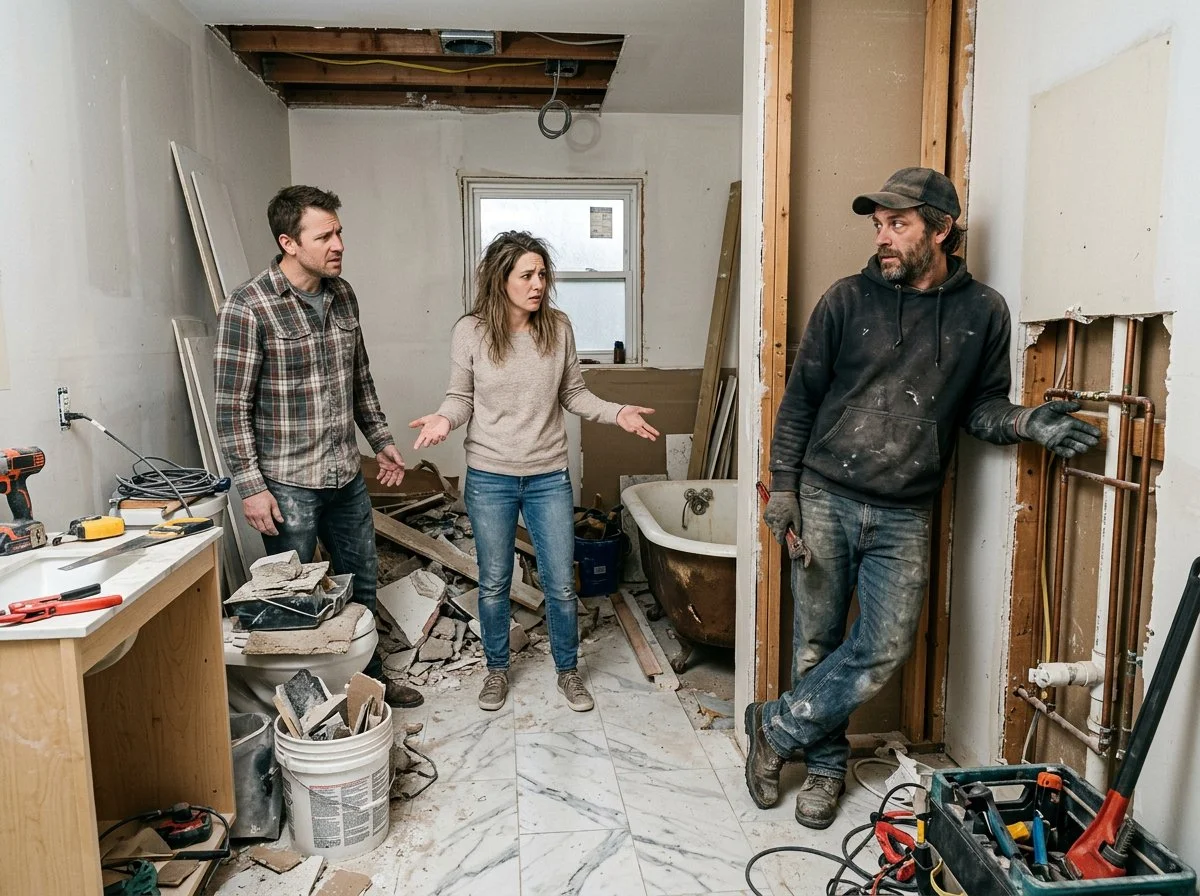
Multiple Reddit commenters described arriving home to find the wrong bath installed, the wrong door trimmed, a wall opened without warning, or a split system quietly removed by the tradie who'd installed it. None of these things happened because tradies are criminals. They happened because no one was there to stop them.
When you're not present, decisions get made without you. Errors compound. Work gets buried under subsequent work. And the window to fix things cheaply — which is approximately thirty seconds after they happen — closes.
The consequence: You find out about problems when they're expensive to fix instead of when they're not.
07. No contingency budget
Every experienced renovator in the thread said the same thing: allow at least 20% above your build budget for the unexpected. Old homes hide termites, asbestos, rotten subfloors, and non-compliant plumbing behind perfectly innocent-looking walls. And then there's the 95-degree hot water system in an apartment bathroom that required an entire new gas installation to bring to legal temperature. That one cost $9,000 in surprises.
The consequence: Renovation halted. Decisions made under financial duress. Corners cut to get the project over the line.
08. Inadequate contracts and payment schedules
Final payments released before work was verified complete. No clear definition of what "finished" actually means. Tradies insisting a job was done when it manifestly wasn't — with no documented completion criteria to point to.
Your contract is your protection. If it's vague, so is your protection.
The consequence: Substandard work signed off under social pressure or time pressure, with no recourse.
09. Not checking licences, insurance, and certifications
This one is so basic it's almost embarrassing to list — and yet it appeared repeatedly in the thread as something people simply hadn't done. In most Australian states, domestic building work over a certain value requires a licensed builder. Electrical, plumbing, and gas work requires licensed tradespeople who must issue certificates of compliance.
Not checking is not due diligence. It's a gamble.
The consequence: Non-compliant work that voids insurance, fails inspections, or can't be sold without rectification.
10. Assuming tradies will communicate with each other
They won't. The sparky assumes the plumber is doing the rangehood flue. The plumber assumes it's the sparky's job. Nobody does the rangehood flue. This is not a hypothetical — it is a verbatim scenario from the Reddit thread, and it is entirely standard.
Tradies each have a defined scope. They work their scope and leave. Co-ordinating between trades, sequencing the build, catching the gaps between disciplines — that is a project management function, not a tradie function.
The consequence: Work done out of sequence, gaps that cost a fortune to rectify, and a build that runs over time and budget.
THE FIXES — YOUR NON-NEGOTIABLE CHECKLIST
Before you request a single quote:
Commission a Scope of Works — developed by your interior designer, not by the builder who will quote on it
Lock in every selection — every tile (and its grout colour, in writing), every tap, every light fitting, every handle, every appliance dimension. Before tender. Not during the build.
Get a lighting and electrical plan designed by someone who understands how people actually live in spaces (usually not the electrician)
Understand your PC and PS items — scrutinise every one, and ask what happens if they run over
Build in a minimum 20% contingency — and treat it as committed, not imaginary
When you're comparing quotes:
Compare exclusions, not just totals — the gap between quotes usually lives in what one builder left out
Ask who will be on site daily and how they manage the coordination between trades
Ask how variations are quoted and approved — get the process in writing before you start
Check licences and insurance — every trade, every time, without apology
Don't choose on price alone — choose on documentation, communication, and references
Throughout the build:
Be present, or have someone present who understands construction sequencing and can make decisions on your behalf
Document every decision in writing — no verbal variations, ever
Define completion before you begin — what exactly needs to be done, inspected, and verified before the final payment is released
Hold the final payment until every item on your completion list is signed off

This was a surprise…
The most telling detail in the entire Reddit thread wasn't a horror story. It was the most upvoted comment — 87 upvotes — which simply said: "Treat every trade like they will end up screwing you over. Get everything in writing."
That comment should not be the most resonant thing in a renovation forum. That level of defensive mistrust should not be the wisdom people are passing down. But it is — because homeowners have been left to learn these lessons alone, without an advocate, without a plan, and without anyone telling them what they needed to know before the quotes went out.
You deserve better than learning the hard way. You deserve a renovation that goes exactly the way it was designed — because it was designed. Properly.
Imagine this scenario…
Imagine turning up to a restaurant, handing the waiter a vague description of what you felt like eating, and then being surprised when the kitchen made something you didn't recognise and charged you extra for the ingredients they'd had to guess at.
You'd never do it. You'd order from the menu. The menu exists because the chef designed it before service began.
Your renovation needs a menu. Your interior designer writes the menu.

In Case You Scrolled Too Fast
The 10 most common renovation mistakes are:
no Scope of Works
tradies making design decisions by default
"builders range" finishes
misunderstood PC and PS items
choosing the cheapest quote
nobody present on site
no contingency budget
weak contracts
unchecked licences
and assuming trades talk to each other.
Every single one is preventable. The full checklist of fixes is in this post — and the full story is in the Reddit thread that inspired it.
You now know what the internet had to learn the hard way.
The question is what you do with it.
Download: Don't Get Ripped Off By Your Reno → The e-book that covers every point on this list — in detail, with examples, and with the kind of insider knowledge the building industry would prefer you didn't have.
Book a Design Power Session → Two hours with Penelope Herbert, Principal Interior Designer at Plush Design Interiors. We'll audit your renovation plan, identify the gaps before they become expensive, and make sure you go to tender with a Scope of Works that actually protects you.
Read the companion post: What a Viral Reddit Thread Revealed About the Australian Renovation Industry →
Love, Penelope xx
Interior Designer + Author of ‘Don’t Get Ripped Off By Your Reno’ and ‘A Home With A Pulse’. Both available on my e-book interior design and renovation resources page on my website.


Plush Design Interiors uses AI‑generated imagery to help illustrate design concepts and possibilities in a fast, flexible and cost‑effective way. These images are inspirational visualisations only and may not represent final selections, exact colours, finishes or products available in Australia. All real‑world Plush Design Interiors work, including all design, specifications, selections and purchases, are curated by a human interior designer and are confirmed with clients using accurate samples, supplier information and detailed documentation before any work proceeds.
FAQ’s 10 Renovations Mistakes Australians Keep Making
Q: What is the most common renovation mistake in Australia? A: Going to tender without a detailed Scope of Works. Without this document, every builder is quoting a different project, and the cheapest quote is almost always the one missing the most inclusions.
Q: What is a Scope of Works in a renovation? A: A Scope of Works is a comprehensive written document that specifies exactly what work is to be done, by whom, to what standard, and using what materials. It is the foundation of every well-run renovation and the document all tradies should quote from.
Q: What does "builders range" mean in a renovation quote? A: Builders range refers to a budget allocation for unspecified finishes — tiles, carpet, stone benchtops, tapware. It represents the cheapest available option. Any upgrade above builders range is charged as a variation, which is why locking in all selections before quoting is essential.
Q: What are PC and PS items in a renovation quote? A: PC (Prime Cost) is a budget allowance for a specific item not yet selected. PS (Provisional Sum) is an estimate for work not yet fully scoped. Both are placeholders — not fixed costs — and both can increase significantly during the build.
Q: How much contingency should I allow for a renovation? A: A minimum of 20% above your build budget. Older homes in particular can hide significant structural, plumbing, or pest issues behind walls that only reveal themselves once demolition begins.
Q: When should I engage an interior designer for a renovation? A: Before you request quotes. Your interior designer should develop your Scope of Works, finalise all your selections, and produce your lighting and electrical plans prior to any builder being invited to tender. Engaging a designer after quotes are received means the most important planning work has already been bypassed.
Q: Do tradies coordinate with each other on a renovation? A: Not automatically. Each tradie works to their own scope and leaves. Coordinating between trades, managing sequencing, and covering the gaps between disciplines is a project management function — either performed by a builder's site manager, a dedicated project manager, or an interior designer working in a design-management capacity.